The Ninety-Minute Legislature: Britain’s Habit of Governing by Instrument
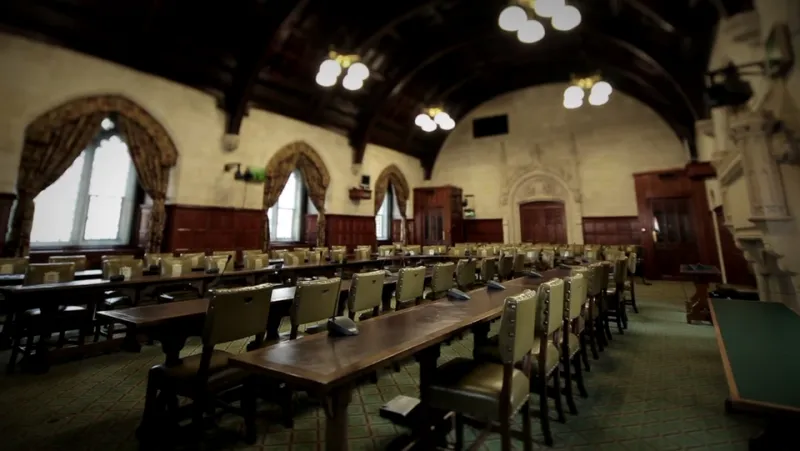
Photo: UK Parliament, CC BY 3.0, via Wikimedia Commons
There is a room in the Palace of Westminster where the law of the land is, for practical purposes, finished. It is not the chamber. The chamber is where the arguments happen, where the cameras are, where the benches fill for statements and empty for the clause stand part debates. The room that matters is smaller, has a clock on the wall, and rarely warrants a sketch in the following morning’s papers.
A statutory instrument committee sits for ninety minutes. It considers perhaps two or three instruments in that time, each of which may alter the operation of a statute passed by the whole House, redraw a fee regime, change a duty, extend a power. No amendment is possible. The minister or a junior reads a prepared opening; a spokesperson responds; a division, if one is pressed at all, follows the whip. Then the room empties and the next set of instruments is laid.
The fastest-growing part of the statute book
Successive governments lay somewhere in the region of three thousand instruments a year. The number of Acts is measured in dozens. The Statutory Instruments Act 1946 gave the machinery its shape and its name; what it did not do was supply a means of refusing anything. Negative procedure instruments become law unless someone prays against them, and almost nobody prays. Affirmative procedure instruments require a vote, but the vote is a formality conducted on a motion that cannot be altered.
This is not a scandal in the ordinary sense. Most instruments are technical, tedious and necessary — commencement orders, fee updates, consequential fixes to cross-references. Anyone who has read one knows the sensation of watching a paragraph repair a comma in a schedule five pages long. But the aggregate is not tedious. The aggregate is a parallel legislature, staffed by departments, operating at a speed and volume the House could not match if it sat through every night of the year.
Delegation that is requested, not seized
The familiar complaint is that the executive has stolen power from Parliament. It is a satisfying line and it is mostly wrong. Ministers rarely take what is not offered. Enabling clauses are drafted in the departments and then voted through by the same members who later complain about them, because the alternative — writing the detail on the floor, line by line, with the clock running — is intolerable to a whips’ office and unattractive to a member with a constituency to serve.
Delegation in Britain is less a coup than a convenience, agreed annually, unremarked. The House gives away the pen because holding it is dull, and because the chamber is a scarce resource that governments would rather spend on announcements. Even the notorious Henry VIII powers — the clauses allowing primary legislation to be rewritten by instrument — pass with small rebellions and large majorities, on the perfectly sincere understanding that this time the power will be used responsibly.
What the precedents left behind
The European Union (Withdrawal) Act 2018 supplied a template: broad powers, an experimental sifting process, and a promise of future scrutiny that never quite arrived. The Retained EU Law (Revocation and Reform) Act 2023 then inverted the direction of the check. Instead of ministers justifying each proposed change, Parliament was invited to catch instruments as they came, in a window too short to read them all. The habit established was not that scrutiny failed, but that scrutiny could be redesigned to fit the volume.
The pandemic did the rest. Regulations made under public health legislation took effect before they were approved; the made affirmative procedure, under which an instrument operates pending a vote it will almost certainly win, moved from emergency exception to ordinary method. Renewal duties, review clauses, forty-day limits — all of it proved that the country can be governed at speed by instrument. Whether the lesson has been unlearned is a question the 2026 session is quietly answering, as bills arrive with frameworks and the detail is left for later.
Why a better committee will not fix it
The House of Lords Secondary Legislation Scrutiny Committee is, by common consent, the best thing in this field. It reads, it questions, it publishes instruments of interest with a lucidity that shames the departments. It also has no power to stop anything, and it sits in the wrong House. Legitimacy in a democracy attaches to the elected chamber, and the elected chamber’s delegated legislation committees are structured as ratification rather than examination.
Nor can any committee read three thousand instruments a year. The arithmetic forbids it. What a committee does is sample, and sampling is a reasonable way to catch the obvious absurdity and an inadequate way to govern a statute book. The constitutional problem is not that the wrong people are reading; it is that the default is silent approval and the burden of interruption falls on whoever happens to notice.
A check worth having
Three changes would do more than any reorganisation of committees.
First, sunset by default. Any new power to amend primary legislation by instrument should expire at the end of the session in which it is granted, renewable only by affirmative resolution of both Houses. The grant becomes a decision rather than an inheritance.
Second, a right of variation. Delegated legislation committees should be able to pass a motion requiring the minister to return within twenty sitting days with a revised instrument. No wrecking amendments, no opposition drafting — simply a demand that the department think again in public.
Third, an annual delegation audit. A return, laid before the House each autumn, setting out how many instruments were made, under which enabling powers, how many were prayed against, and how many were debated on the floor. Parliament cannot weigh what it does not count, and at present it does not count.
The swarm and the hive
The instruments are not the enemy. Modern government cannot be conducted from a green bench, and a state that insisted on legislating every fee in primary statute would simply legislate less. But a hive without an accounting is not a marvel of organisation; it is a swarm nobody can track. The remedy is not to reclaim every power. It is to make the giving of it deliberate, visible and reversible — and to stop pretending that ninety minutes in a side room is the same as consent.
The Unhived Mind takes no view on whether the present government is worse than its predecessors in this respect. The pattern long predates it, and will outlast it, unless the House decides that the pen is worth holding.