The Deliverable Is the Document: Britain’s Mission Government and the Flight from Priority

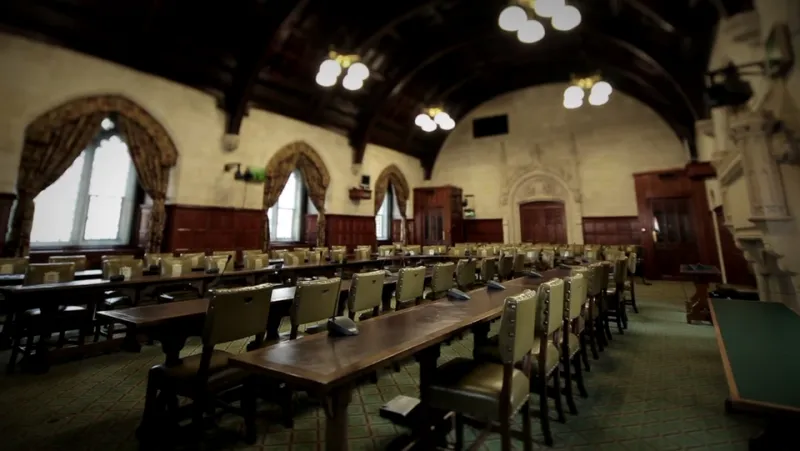
Photo: Whitehall government meeting room officials dashboard mission statement stock photo, via everycastle.com
Mission-led government has become the organising grammar of Whitehall. The phrase appears in ministerial forewords, departmental plans, delivery board agendas and the titles of units that sit slightly to one side of the old hierarchy. The mission is presented as a cure for short-termism: a fixed star by which departments can align their efforts. Yet the more closely one examines the machinery, the more the mission statement looks less like a governing philosophy and more like a document that allows government to postpone the moment of choice.
That is not a trivial objection. Politics is not a seminar in which all good things can be pursued at once. It is a system for allocating scarce resources, attention and authority. Every serious governing programme must say not only what will be done but what will not be done, and who will notice the difference. The mission statement, by contrast, is designed to include. It gathers housing, health, growth, security and the climate into a single frame, then asks departments to demonstrate their contribution. The frame is broad enough to accommodate almost any activity, which is precisely its political utility.
The boardroom as constitution
The architecture of mission government is now familiar. There are mission delivery boards, central units, cross-departmental teams and an array of performance indicators. Ministers chair meetings; officials prepare packs; dashboards turn complex public questions into red, amber and green. None of this is inherently absurd. Governments have always needed ways of coordinating departments, and the British state has long been fond of committees. What is new is the extent to which the committee has become the constitution.
The delivery board is not merely a place where decisions are discussed. It is increasingly the place where responsibility is diffused. A mission that runs across several departments has no single owner in the way that a departmental budget has an owner. The Cabinet Office can convene; the Treasury can fund; the relevant department can deliver. When something goes wrong, each can point to the others with a straight face. The mission survives because no one is required to resign over it.
This is the quiet attraction of the cross-cutting objective. It promises action without creating a single point of failure. It allows a government to say that it is tackling a problem seriously while leaving the hard institutional question unanswered: who is actually in charge, and what will they be held to?
The metric is not the mission
The dashboard is the mission statement’s natural companion. It offers the comforting appearance of precision. Numbers are gathered, trends are plotted, and progress is declared. But a dashboard measures what has been chosen for measurement, not what matters politically. A target for appointments or planning applications may rise while public confidence falls. A headline figure may improve because the definition has changed, or because activity has been displaced rather than solved.
The deeper problem is that dashboards cannot record a trade-off. They can show that more houses have been consented, but not that a local plan has been imposed on a unwilling community. They can show that a programme has reached more people, but not that it has displaced another service. They can show that a mission is ‘on track’ while the political argument about its costs remains unresolved. The metric becomes a way of not having the argument.
Ministers are not obliged to govern by spreadsheet. But the spreadsheet has a seductive quality in a system that fears ambiguity. It allows a government to claim momentum without specifying sacrifice. It turns a political question — should this be done, at this cost, instead of something else? — into a management question of delivery.
Cross-cutting means no one cuts
The most revealing phrase in mission government is ‘shared ownership’. In theory it means collaboration. In practice it often means that no single minister has the authority, or the incentive, to stop something. A mission that belongs to everyone belongs to no one. The result is a proliferation of workstreams, pilot schemes and ministerial letters, all of which can be presented as evidence of action.
This is particularly visible in areas where the real decision is distributive. Housing, for example, is not merely a question of supply targets. It is a question of where new homes go, what they look like, who pays for the infrastructure and which existing residents are expected to absorb the change. A mission statement can announce an ambition to build. It cannot, by itself, decide whether the green belt is sacrosanct, whether local objections carry weight, or whether the Treasury will fund the roads and surgeries that follow. Those are choices, and choices create losers.
The same is true of health, energy, skills and transport. Each mission contains within it a series of unresolved arguments about money, land, labour and time. The mission statement does not resolve them. It provides a language in which they can be deferred.
The missing sentence
A serious governing document should contain a sentence that mission statements almost never include: this will cost that, and that will not happen. It should name the programme that will be closed, the budget that will be held flat, the constituency that will wait longer, the sector that will be asked to adjust. Without such sentences, the mission is not a plan. It is a mood.
Britain has had no shortage of moods in recent years. The present government’s five missions, announced after the 2024 election, are the most recent expression of a longer habit: the belief that a sufficiently broad objective can substitute for a sufficiently difficult decision. But the habit predates any single administration. It is embedded in the way Whitehall rewards coordination over closure and presentation over priority.
Fewer promises, clearer losses
The contrarian conclusion is not that missions are worthless. It is that they are useful only when they are subordinate to a smaller number of explicit priorities. A government that means to change things should be willing to say which voters, sectors and pet projects will lose out. It should name the minister who owns the decision and the date by which it will be taken. It should accept that a dashboard is a tool, not a verdict.
As 2026 unfolds, the temptation will be to add another mission, another board, another indicator. The Unhived Mind’s objection is simple: the swarm of objectives is not a strategy. Britain does not need more mission statements. It needs fewer priorities, clearer ownership and a political class willing to say the unpopular sentence out loud. Until then, the deliverable will remain the document — and the decision will remain somewhere else.