Before the First Seminar: Britain’s Universities and the Bureaucracy of Foreknowledge
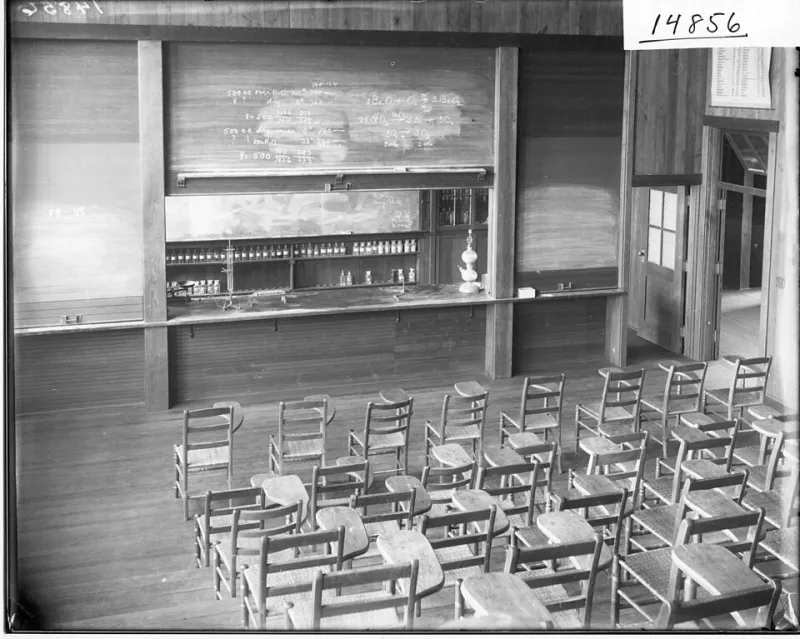
Photo: Snyder, Frank R. Flickr: Miami U. Libraries - Digital Collections, Public domain, via Wikimedia Commons
There is a document that now precedes the seminar as reliably as the timetable. It runs to fifteen or twenty pages. It lists the module’s aims, its learning outcomes, the mapping of those outcomes onto the programme’s outcomes, the assessment matrix, the weighting of each component, the reading for each week, the feedback turnaround, the attendance policy and the statement of what a student may expect to be able to do by the end. It is published weeks before term begins, sometimes before the lecturer has met the group, occasionally before the lecturer has finished writing the lectures.
It is called a module descriptor. It is treated as a neutral instrument of good practice. It is neither neutral nor merely instrumental.
The Document That Arrives Before the Thought
Consider what the descriptor actually does. It commits the teacher to a set of declared outcomes before the teaching has occurred. It converts an intellectual encounter into a specification. It gives the student a schedule of what they are to receive, in the manner of a service level agreement, and it gives the institution a record that the service was specified in advance.
None of this is unreasonable on its own terms. Students paying nine thousand pounds a year are entitled to know what they have bought. Regulators are entitled to evidence. The difficulty lies in what the format silently excludes. A seminar that genuinely changes how a student thinks is rarely the seminar that was described in week one. The good question is the one the reading did not anticipate. The productive detour is the one that costs a fortnight of the syllabus.
A descriptor cannot record a detour. It can only record a deviation.
Legibility as a Settlement
The machinery behind the descriptor is now dense and formal. The Office for Standards in Education has no purchase here; the relevant body is the Office for Students, whose conditions of registration require institutions to demonstrate quality and standards through documented processes. Consumer protection law, imported into the sector by the Competition and Markets Authority in the 2010s and never fully repatriated, treats the student as a purchaser of a defined service. The Teaching Excellence Framework asks institutions to evidence teaching quality through metrics and narrative. The QAA’s subject benchmark statements describe the expected shape of a discipline. Each instrument is defensible. Together they produce a single imperative: the course must be described before it is taught, and the description must be auditable.
This is the settlement. In exchange for fees, autonomy and the right to call themselves universities, institutions accept that their intellectual life will be rendered in a format a regulator can read. The format is not a conspiracy. It is the price of the licence.
But settlements have costs, and the costs are usually paid by the least powerful party in the room — in this case, the seminar group.
What the Matrix Cannot Hold
The assessment matrix is a good example. It tells the student that the essay is worth sixty per cent, the exam thirty, participation ten. It does not tell them that the most important thing they will do this term is argue with a tutor for forty minutes about a paragraph neither of them understands. That cannot be weighted. It cannot be mapped onto a programme outcome. It cannot be reported to a committee.
So it is not weighted, mapped or reported. It persists because individual academics persist in doing it, often against the grain of their own paperwork, and it survives in the gaps between the columns. The audit machine does not forbid the unmeasurable hour. It simply declines to notice it, and over time the unnoticed hour becomes the discretionary hour, and the discretionary hour becomes the hour that is cut when the timetable is compressed.
This is how a culture changes: not by prohibition, but by the slow reclassification of the essential as optional.
The Case for the Unoptimised Hour
A contrarian case can be made here, and it does not require nostalgia for the 1970s or a defence of the worst teaching the sector has ever produced. It requires only the recognition that education is one of the few remaining activities in British public life whose value is partly constituted by its inefficiency. A seminar that wastes time — that follows a wrong turn, that lets a bad argument run, that ends without a conclusion — is not a failed seminar. It is the seminar doing the one thing no descriptor can promise: allowing the student to discover what they actually think.
The alternative is a system in which every hour is accounted for and no hour is unaccounted for, which sounds like rigour and is in fact a veto on surprise.
A Modest Proposal, Reversed
Institutions are currently considering how to respond to the next round of registration conditions and how to evidence the things the framework now asks them to evidence. The temptation will be more documentation, earlier publication, finer granularity. The contrarian move would be the opposite: to write descriptors that admit uncertainty, to leave at least one week of each module undeclared, and to defend in the committee room the proposition that a course of study is not a specification but an invitation.
That defence will be difficult. It cannot be evidenced in the format the regulator prefers. It will sound, to a compliance officer, like an excuse. But the audit machine has one weakness: it can only measure what it has already been told to expect. The unoptimised seminar remains, for now, outside its reach. The question is whether anyone in a position to protect it still believes it is worth protecting.