The Unattributed Chamber: Britain's Second House of Anonymous Sources
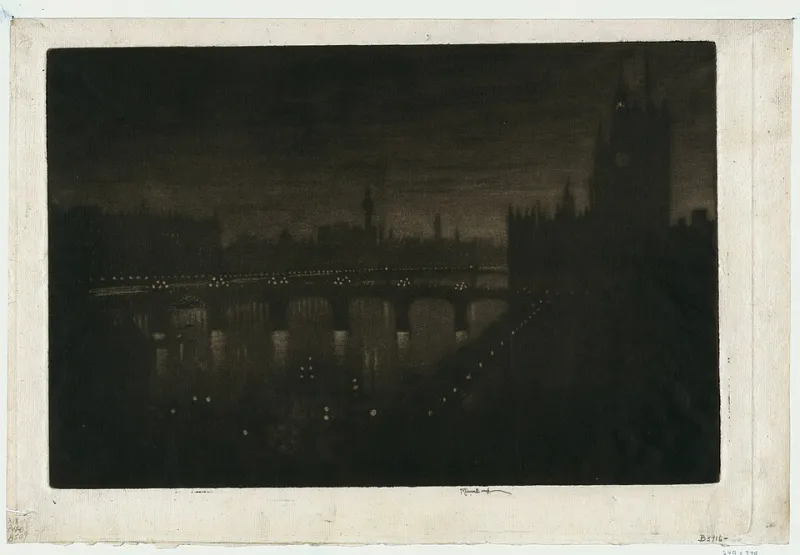
Photo: Pennell, Joseph, 1857-1926, artist, Public domain, via Wikimedia Commons
There is a familiar rhythm to the modern political week. A Sunday paper carries a story, sourced to "a senior government figure", disclosing that a minister is "fighting for her political life". By Monday the broadcast studios have converted the claim into a question. By Tuesday the department has issued a statement that neither confirms nor denies. By Wednesday the minister is gone, and the obituaries note, accurately, that her departure had been signalled days in advance.
At no point in this sequence did a vote take place, a committee sit, or a decision be minuted. Yet a decision was unmistakably made, and made in public — just not in any of the public places the constitution recognises.
The Trial Balloon as Second Reading
The unauthorised briefing has long been a feature of Westminster life, and there is a respectable case for it. Governments leak to test reactions, to discipline colleagues, to bypass a hostile press office, and occasionally to tell the truth where the official line will not permit it. The conventional defence holds that leaks are transparency by other means: the public learns earlier than it otherwise would.
That defence is now doing work it cannot bear. A leak is not transparency because a leak has an author with an interest. What is disclosed, in what order, framed in which adjectives and placed with which columnist, is a series of choices — and those choices are made by people who are accountable to nobody the reader can identify. Transparency, properly understood, is a rule that requires disclosure. A briefing is a favour that may be withdrawn.
Consider what a trial balloon actually does. A proposal is floated in a friendly outlet. The reaction is measured: backbench grumbling, Treasury alarm, a focus group or two. The policy then emerges — or does not — in a form shaped entirely by that unrecorded consultation. By the time the formal announcement arrives, the argument has already been had, and the green paper has become a press release summarising a conversation the public was invited to overhear but not to join.
That is not scrutiny. It is pre-emption dressed as revelation.
The Diary as Order Paper
Something subtler has happened to the political calendar itself. The timetable of government used to be set by the parliamentary session: the Queen's Speech, the Budget, the estimate days, the recesses. Those still exist, but they no longer govern attention. Attention is governed by the communications grid — the rolling plan of announcements, visits, interviews and planted stories that determines what the political system will spend its week discussing.
A pre-Budget trail is the clearest specimen. Weeks before the Chancellor rises, the likely measures are already in circulation: this tax rumoured, that allowance spared, a "difficult decision" softened in advance. Each story performs a function the Budget statement once performed, but without the binding quality of the despatch box. If the reaction is bad, the measure evaporates and no one was ever committed to it. If the reaction is good, the Chancellor claims the credit twice — once in the papers, once in the Commons.
The same machinery handles the minister in difficulty. A resignation that could have been a matter for the Prime Minister's judgement becomes instead a slow public negotiation conducted through unattributed quotes, in which the outcome is decided by whether the story "has legs". The verdict arrives before the evidence, and the evidence is then assembled to fit.
What the Lobby Knew
The machinery depends on a small number of people. Lobby journalists, special advisers, a handful of officials with a taste for the game — a network of perhaps a few hundred, most of whom know one another, all of whom trade in the same currency of access. This is not a conspiracy; it is a market. Access is the asset, and the price of access is discretion about where the story came from.
That market has a distorting property. It rewards those inside the network and penalises those outside it. A department that refuses to play finds itself described as "leaky" or "dysfunctional" by the very people it declined to brief. A minister who insists on formal channels is written up as aloof. The incentives point one way, and they have pointed that way for decades, but the volume has changed. What was once a supplementary channel has become the primary one, with the formal process trailing behind it, tidying up.
Scrutiny Without a Record
The constitutional objection is not that leaks happen. It is that they now carry the deliberative weight that ought to belong to institutions that keep minutes. A select committee can compel evidence and publish it. The Commons can require a statement. The courts can demand reasons. An anonymous briefing can do none of these things, and it is answerable to none of them — yet it increasingly performs the function all three were designed to serve.
The consequence is a peculiar kind of amnesia. Decisions are made, and then unmade, in a medium that leaves no trace. Years later, when the inquiry is commissioned and the learned counsel asks how a policy came to be adopted, the answer will be found in WhatsApp threads that have been auto-deleted and in newspaper cuttings whose sources are dead or silent. A system that deliberates through deniable channels will, in the end, be unable to explain itself.
The Cost of Plausible Deniability
None of this argues for a leak inquiry or a tighter embargo. Suppressing briefings would not restore the Commons to its former centrality; it would simply move the conversation further out of sight. The problem is deeper than discipline. It is that the visible institutions have become slow, ceremonial and comparatively unrewarding, while the invisible ones are fast, consequential and free of consequence.
A serious response would begin by making the formal channels worth using: statements that contain information rather than positioning, committees with real timetables and real powers, a Budget process in which the numbers are published before they are spun. Until then, Britain will continue to be governed in two places at once — one of them on the record, and one of them in Monday's paper.
It is the second one that decides.