The Whitehall Immune System: Three NHS Taboos That Outlast Every Reorganisation
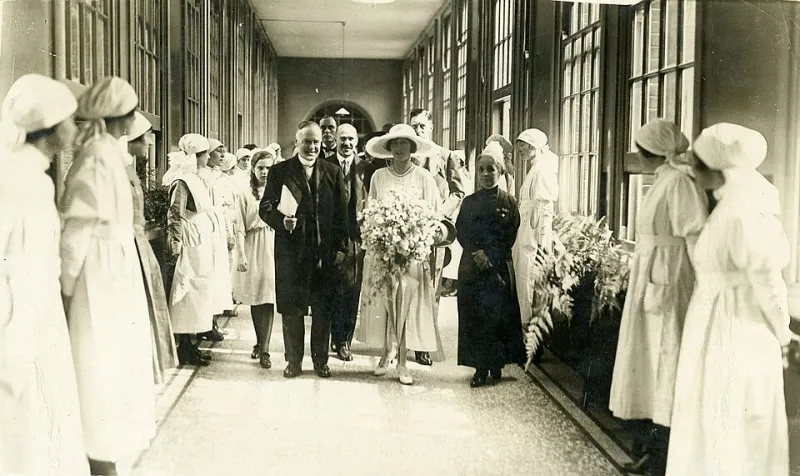
Photo: Template:Aitken, Ltd. 47 Fleet St, London, E.C.4., CC BY-SA 4.0, via Wikimedia Commons
No institution in British public life commands such unbroken verbal reverence as the National Health Service. Ministers of every stripe compete to demonstrate that theirs is the safer pair of hands, and the competition is conducted almost entirely in the currency of protection. The consequence is a peculiar form of political paralysis: reform is announced constantly, restructured frequently and evaluated rarely, because any proposal that survives contact with the taboos has already been hollowed out before it reaches a ward.
What follows is not an argument for dismantling the NHS. It is an argument for letting three propositions be examined in public, on their merits, without the immediate assumption of bad faith that currently greets anyone who raises them.
I. The universalism taboo
Universality is treated in British politics as synonymous with the service itself. To question its operational meaning is to be accused of wanting something foreign and cruel, and the accusation usually lands before any distinction has been drawn. Yet universalism is not a single thing. A universal entitlement to care is not the same proposition as a universal subsidy of every service, at every level of income, at the moment of delivery.
The present settlement rations chiefly by time. Waiting is the mechanism, and waiting is not distributed evenly. Those with the money, the flexibility or the employer-provided insurance to step outside the queue do so — not by leaving the system, but by buying their way around its slowest parts. That is not a scandal; it is simply what happens when demand is open-ended and supply is fixed. But it means the system’s equality is increasingly formal rather than practical, and the taboo ensures nobody has to say so on the record.
A serious defence of universality would specify what it should guarantee: an entitlement to timely care, certainly; a subsidy targeted at need, possibly; a uniform standard of dignity, always. Instead we get a slogan, and slogans are the enemies of specification.
II. The centralisation taboo
Britain operates one of the most centrally directed health systems in the developed world, and yet the word ‘national’ is doing so much rhetorical work that the structure itself escapes scrutiny. Every reorganisation for forty years has been sold as a return of power to the front line and delivered as a redrawing of the map from the centre. Trusts merge, integrated care boards are instructed, arm’s-length bodies are created and dissolved, and the direction of travel never quite changes.
The digital layer is the clearest illustration, and it is why this argument belongs under the heading of digital politics rather than clinical administration. A single patient record, a national application through which appointments and information are routed, a federated data platform holding information drawn from every trust, a stated preference for digital-first access: each is presented to the public as plumbing. None is merely plumbing. Data architecture is governance. Whoever defines the schema defines what can be asked of the system; whoever holds the record holds the leverage; whoever sets the interoperability standard has decided, in advance, which local variations will survive.
The counter-argument deserves respect. Fragmentation is expensive and dangerous, standards do not enforce themselves, and patients care far less about institutional geography than about whether the appointment happens. Fair enough. But that argument should be won rather than assumed. The taboo prevents the useful distinction between functions that genuinely require national direction — procurement at scale, safety standards, emergency preparedness, research infrastructure — and functions that are national only because nobody has been brave enough to let go of them.
III. The free-at-the-point-of-use taboo
The mantra is repeated as though it described the system we have. It does not, and it has not for decades. Prescription charges persist in England while being abolished elsewhere in the United Kingdom. Dentistry is free for some and effectively unavailable for many. Optical care, parking, travel, the costs that cluster around illness — all involve money changing hands. The pretence that the principle is intact while the exceptions multiply means that no principle at all governs the exceptions. They accumulate by habit and by budget settlement.
Meanwhile the largest charge of all is levied in time. A waiting list is a co-payment denominated in pain, lost earnings and deteriorating health, and it is charged most heavily to those with least capacity to absorb it. If the point of the founding principle was that illness should never be a transaction, then the current arrangement fails on its own terms.
Raising this invites the reply that any discussion of charges is an American import. That is a debating move, not an argument. The choice is not between the status quo and a market free-for-all; there is a wide space between them, and the taboo is the reason it is never mapped.
Why the sacred cows graze undisturbed
The electoral logic is obvious and rarely stated. No party wishes to be the one that appeared to break the institution, so each polices the other’s language more fiercely than its own performance. But the institutional logic matters more. A dense ecology of bodies — the department, the national body, the royal colleges, the unions, the supplier base, the health correspondents — has a stake in the current vocabulary. Reform proposals that touch the taboos do not fail on evidence. They fail on framing, and the framing is set before the evidence is gathered.
What unhiving actually requires
It does not require adopting any of the positions above. It requires making them arguable. Three modest steps would do more than another structural reorganisation.
First, separate entitlement from subsidy in official language, so that the question of what is guaranteed and to whom can be asked without triggering an alarm. Second, submit the digital centralisation programme to the same parliamentary scrutiny as any other transfer of power, on the grounds that a data platform is a constitutional instrument wearing a lanyard. Third, publish honestly what is already charged for, in money and in waiting time, so that the founding principle can be restated in terms that match the system it describes.
None of this is dramatic. It is the ordinary work of a legislature that has stopped treating a beloved institution as an argument-ending device. Until it happens, reform will keep arriving as reorganisation, reorganisation will keep arriving as reassurance, and the sacred cows will keep grazing — well fed, undisturbed and quietly expensive.